Get in touch
Sales Enquiries
+977 9801037556 (Nepal) +44 20 3336 9262 (UK)Career or Job Applications
hello@omegaincorporations.com


Why Your UK Website Isn’t Ranking on Google
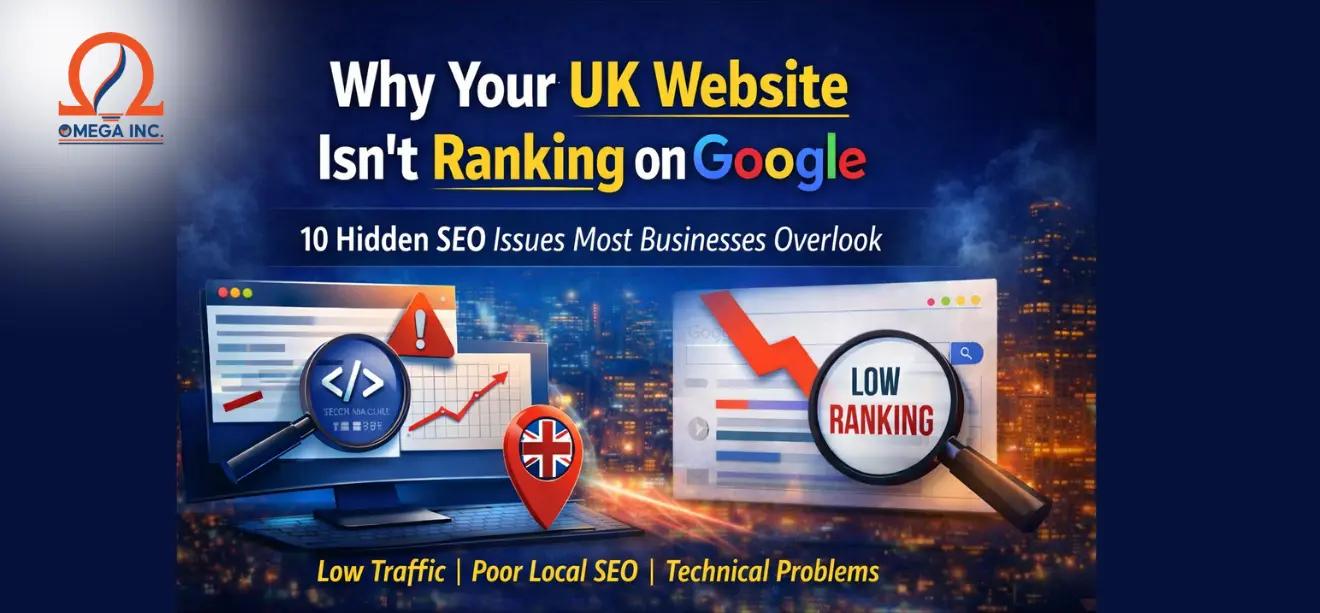
10 Hidden SEO Issues Most Businesses Overlook
You’ve invested time, budget, and effort into your website. The design looks professional. The content explains your services clearly.
Yet when potential customers search on Google your site barely shows up.
If that sounds familiar, the issue isn’t your business. It’s hidden SEO problems quietly blocking your visibility.
Most UK businesses focus on obvious SEO tasks like publishing blogs or building a few backlinks. But Google doesn’t rank effort it ranks clarity, relevance, trust, and user experience. When even one of those breaks, rankings suffer.
In this guide, you’ll discover the 10 hidden SEO issues that stop UK websites from ranking and what you can do to fix them. By the end, you’ll also have a clear 90-day action plan to restore organic visibility and generate higher-quality traffic.
The Real Cost of Not Ranking on Google
When your website isn’t visible on search engines:
Customers find competitors instead of you
Paid ads become more expensive to compensate
Your website acts like a brochure, not a sales channel
Growth slows even though demand exists
SEO issues rarely announce themselves. They silently drain opportunities every single day.
1. Ignoring Local SEO Opportunities (A Major UK Ranking Problem)
Local search is essential for UK businesses serving specific towns, cities, or regions. Google’s “near me” behaviour is now mature, and users expect location-specific results.
If your website is generic and location-blind, you lose visibility.
What to check:
Claim and fully optimise your Google Business Profile (GBP)
Ensure consistent Name, Address, Phone (NAP) across directories
Build unique service-area or location pages (avoid duplicated content)
Metrics to monitor:
GBP profile views and actions
Local-pack impressions in Google Search Console
Calls and direction requests
Why it matters:
Local relevance fuels Google Maps and local pack rankings. Without it, you’ll struggle to appear for searches with city or regional intent even with decent domain authority.
2. Poor Keyword Strategy: Targeting the Wrong Searches
A scattergun keyword approach wastes time and budget. Ranking for broad terms often attracts the wrong visitors who don’t convert.
UK businesses need an intent-driven keyword strategy.
What works better:
Prioritise long-tail, geo-modified keywords
Map keywords to specific pages (one intent per page)
Build topic clusters around core service pages
Metrics to track:
Organic sessions by query
Average ranking position
Conversion rate per landing page
If users land on a page that doesn’t match their intent, they bounce signalling to Google that your page isn’t satisfying searchers.
3. Technical SEO Errors Blocking Crawlability and Indexing
Even the best content won’t rank if Google can’t access it.
Common hidden blockers:
Accidental no index tags
Incorrect robots.txt rules
Canonical tag misconfigurations
Broken sitemap URLs
Server errors after updates
How to fix:
Run a full crawl using Screaming Frog or Sitebulb
Review the Coverage report in Google Search Console
Use URL Inspection to test priority pages
A single technical error can de-index entire sections of a website overnight.
4. Slow Page Speed & Failing Core Web Vitals
Page speed is no longer optional. Google evaluates real user experience, not just content quality.
Key metrics:
LCP (Largest Contentful Paint)
CLS (Cumulative Layout Shift)
INP (Interaction to Next Paint)
Common causes:
Large uncompressed images
Render-blocking JavaScript
Poor hosting or caching setup
Start by optimising your top 5 traffic pages and they deliver the fastest impact.
Slow pages increase bounce rate, reduce engagement, and weaken rankings.
5. Lack of Mobile Optimisation (Mobile-First Indexing)
Google indexes the mobile version of your site first.
Common mobile issues:
Small tap targets
Difficult navigation
Hidden or missing content
Poor mobile speed
A desktop-only mindset is outdated. Improving mobile UX often results in immediate ranking and conversion improvements.
6. Thin, Duplicate, or Low-Value Content
More pages don’t mean better rankings. Pages that add no unique value are often ignored.
Warning signs:
Repeated service descriptions
Manufacturer-copied product text
Very short pages with no depth
What to do:
Consolidate similar pages using redirects or canonicals
Expand thin pages with FAQs, case studies, and local insights
Remove pages that cannot be improved
If a page doesn’t deserve to rank, Google won’t rank it.
7. Weak Backlink Profile: Relevance Beats Quantity
Backlinks still matter but relevance matters more than volume.
What Google prefers:
Contextual links from relevant websites
Local and industry-specific authority
Natural link growth over time
Focus on competitor backlink gap analysis, digital PR, guest content, and link-worthy assets.
Avoid shortcuts low-quality links cause long-term damage.
8. Missing E-E-A-T Signals (Experience, Expertise, Authority, Trust)
Google evaluates credibility, especially for service-based and YMYL topics.
Strengthen trust by:
Adding author bios and credentials
Publishing case studies with outcomes
Maintaining clear privacy and policy pages
Using HTTPS and secure practices
Your offline credibility must be visible online.
9. Poor On-Page SEO & Missing Schema Markup
Sometimes the simplest fixes deliver the biggest gains.
Common issues:
Duplicate or weak title tags
Poor heading structure
Missing image alt text
No structured data
Opportunities:
Optimise titles for intent and click-through
Implement FAQ, LocalBusiness, Product, or Review schema
Improve internal linking
On-page fundamentals help Google understand your site and users choose your result.
10. Treating SEO as a One-Off Task
SEO is not “set and forget”.
Without monitoring:
Rankings decay
Competitors overtake
Algorithm updates hit harder
Successful SEO requires continuous testing, measurement, and iteration — like product development.
A Clear 90-Day SEO Recovery Plan
Days 1–14: Fix Critical Blockers
Resolve indexing and crawl issues
Correct robots.txt and no index tags
Resubmit sitemap in Google Search Console
Days 15–45: Speed & Mobile Optimisation
Improve Core Web Vitals
Optimise high-traffic pages
Fix mobile usability issues
Days 46–90: Content & Local Growth
Optimise Google Business Profile
Build or improve location pages
Expand thin content into valuable resources
Quick Wins You Can Implement Today
Claim and optimise your Google Business Profile
Run PageSpeed Insights on your top pages
Use URL Inspection to confirm key pages are indexed
Get a Free SEO Health-Check
If your website isn’t ranking, something is broken, not your business.
At Omega Incorporations, we provide a structured SEO health-check and a tailored 90-day action plan aligned with your business goals.
Get a free SEO audit and actionable roadmap.
No pressure. No fluff. Just clarity.
Frequently Asked Questions
Why is my website not ranking on Google UK?
Common causes include indexing issues, poor local SEO, slow pages, thin content, or weak authority.
How quickly can SEO fixes work?
Technical fixes can show impact within days. Content and authority improvements usually take weeks to months.
Do I need a separate UK website?
Most businesses perform well with a single UK-focused site using proper localisation.
What is the fastest local SEO win?
Fully optimising your Google Business Profile and ensuring consistent NAP details.
Should I fix technical or content issues first?
Always fix indexing, speed, and mobile issues first then improve content and backlinks.