Get in touch
Sales Enquiries
+977 9801037556 (Nepal) +44 20 3336 9262 (UK)Career or Job Applications
hello@omegaincorporations.com


How AI Is Transforming Marketing Automation and Revenue Growth
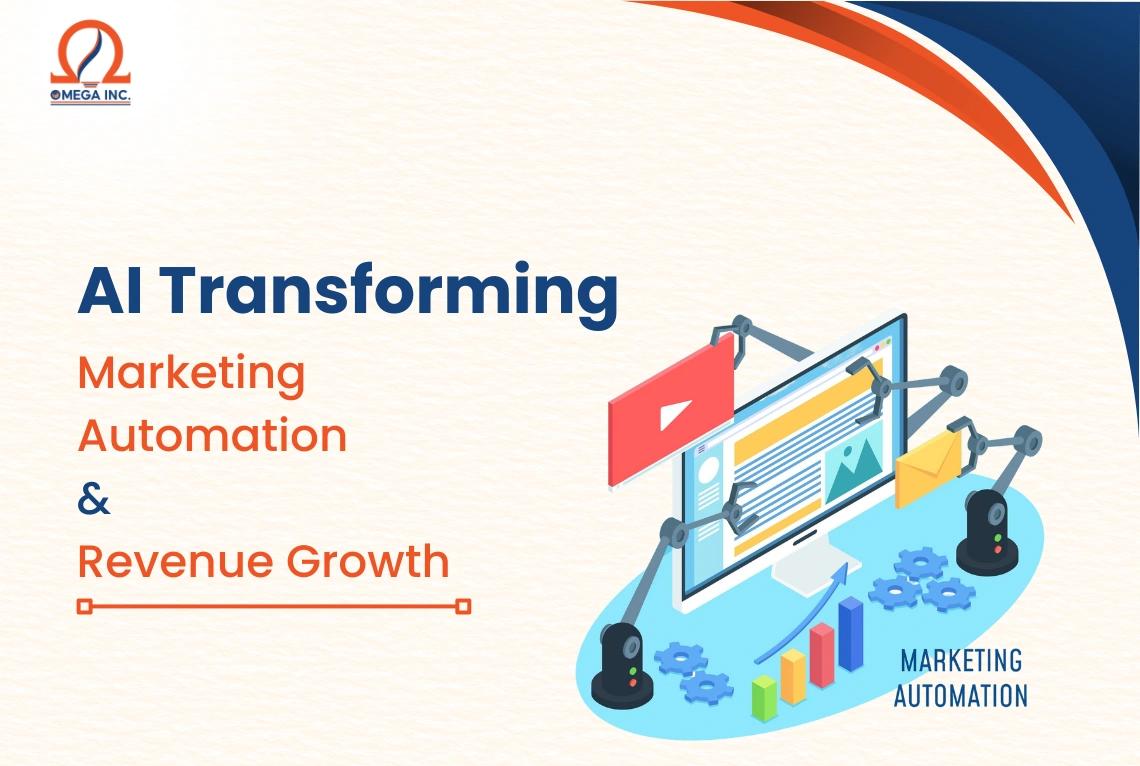
2025 marks a turning point for marketing. After a few years of experimentation, AI marketing automation has moved from idea to everyday reality. What marketers once did through rule-based flows and by hand segmentation, they now implement machines that learn, adapt, and act in real time. The result is not only more efficient operations but revenue gains measurable by the pound.
This article explains what changed, why some capabilities such as generative AI marketing and AI agents in marketing add value, and how effective steps teams can take today to seize upside. You will be able to access use cases, an implementation roadmap, governance best practices, and references to helpful resources from Omega Incorporations. The objective is simple: show how to turn AI-powered automation into repeatable revenue, without unnecessary risk.
AI-Powered Marketing Automation: What's New by 2025
The shift to AI marketing automation isn't incremental. It is architectural.
Previously, marketing automation platforms executed predefined rules: send this email in seven days, route leads with score X to sales, etc. Those systems were great for volume but were not flexible. Today's platforms are marrying several distinct technological advancements:
Language and multimodal models that read copy, images, and behavior holistically.
Live streaming data that updates user profiles in real-time.
Probabilistic attribution and causal models that better explain what activities actually generated revenue.
Native model integrations within martech that reduce the level of custom engineering.
These changes do count because they shift the location of value. Optimization is continuously algorithmic, not slow, human activity any longer. Budgets are reallocated when models identify better returns. Offers and creative adapt to what each user is showing them at the current time. Attribution is more transparent so that teams can place bets where lift is real, not perceived.
If you're considering your stack, familiarity with digital modernization is essential. To get a summary of why systems modernization matters and how it facilitates AI initiatives, read What Is Digital Transformation on our blog. That context guides choosing what to integrate first.
Personalization at Scale: How Generative AI Enhances Conversions
Personalization used to be segmenting into a handful of groups. Now, personalization at scale is attainable because generative AI marketing is able to generate content versions on demand and correlate them to micro-segments.
How it plays out in the real world:
Models ingest first-party signals such as historical buys, content engagement, ad clicks and make inferences about intent.
Generative tools create personalized subject lines, headlines, and short-form creative that correlate to inferred intent.
Promotions and landing pages are dynamically served according to the user's likely needs and desires.
Concrete examples:
Email promotions whose content is adjusted depending on past interaction. A demo watcher gets a tech case study. A pricing visitor gets an expiring offer.
Ads where headlines and graphics are programmatically blended individually to serve thousands of variations, with the top-performing combinations amplified automatically.
Native-like local content across multiple languages without exhaustive translation cycles.
To build effective personalization, combine sound data hygiene with creative imagination. For the marketing basics to be used alongside personalization efforts, read What Is Digital Marketing? Strategy Breakdown for Small Businesses.
Predictive Analytics & Lead Scoring: Shortening the Sales Cycle
One of the most glaring AI revenue impacts is lead prioritization. Predictive analytics marketing turns history into forward-looking scores. Guesswork is a thing of the past; action on signals is the new reality.
How predictive scoring helps:
Models learn what behaviors and firmographics predict closes.
Leads receive dynamic propensity scores that update as fresh signals arrive.
High-propensity leads are routed to the best channel and right sales rep at the right time.
Operational advantages are real-time:
Faster conversion of MQL to SQL due to staff concentrating on leads most likely to convert.
Less wasted hours of outreach on sales development reps.
Improved marketing activity to sales outcome alignment.
Implementing predictive scoring requires prioritizing three practical items:
Data readiness: CRM and marketing automation histories should be clean and linked.
Retraining schedule: Models require regular updates to adapt to changes in products or markets.
Integration: Score results should trigger routing rules and workflow automations in your CRM.
It occasionally requires the services of engineers to provide the technical plumbing. You might need help developing good pipelines. Think about choosing the Right Outsourcing Partner.
Autonomous AI Agents & Workflow Automation
Automation used to stop at scheduled flows. Today, AI agents in marketing operate continuously, testing, pausing, and reallocating without waiting for human input.
What agents do:
Run continuous A/B tests and scale winners.
Reallocate ad spend based on daypart performance and ROI thresholds.
Detect anomalies and trigger defensive actions, such as pausing an underperforming creative.
A simple agent workflow looks like this:
Monitor: detect when acquisition cost rises above a preset threshold.
Act: reduce spend on low-value segments and increase spend on high-ROI ads.
Notify: surface the action and result for human approval.
Agents accelerate and liberate teams to do strategy. But guardrails are necessary. Operational guidelines must comprise spend caps, brand voice limits, and human-in-the-loop approvals for high-impact actions. Agents should also be equipped with audit logs to allow compliance and post-mortems.
If you're deploying agents at scale, then partner selection matters. Integrate in mind when building or buying. Read How to Choose the Right Outsourcing Partner. The right partner lowers risk and accelerates delivery.
Measuring ROI: Attribution, Experimentation, and Revenue Modeling
If automation is driving your campaigns, measurement must be precise. AI marketing ROI depends on rigorous attribution and responsible testing.
Measurement approaches that bring transparency:
Use multi-touch and probabilistic attribution to distribute credit equally among touchpoints.
Conduct causal inference and holdout tests to estimate true incremental lift over baseline performance.
Connect campaign signals to pipeline results rather than simply surface metrics like clicks.
Key KPIs to track:
Customer acquisition cost and lifetime value.
Conversion rate from marketing-qualified leads to close deals.
Revenues to AI processes.
Metrics of efficiency, such as hours saved in campaign ops.
Cadence in reporting matters. Perform weekly anomaly checks to catch sudden issues. Create monthly trend reports for strategic decisions. And schedule quarterly lift tests to confirm long-term value.
Roadmap to Implementation: How Companies Can Reach for Revenue from AI Automation within 90–180 Days
AI marketing implementation must be realistic, staged, and trackable. The subsequent roadmap aligns with actual timelines and results.
Phase 1: 0 to 30 days
Audit your martech and data: map CRM, marketing automation platform, analytics, and ad accounts.
Choose low-complexity, high-impact pilots such as email personalization or ad creative optimization.
Check security and compliance requirements. If certificates matter, look for providers with a focus on controls and standards, e.g., ISO 27001. Visit Services to find out about the compliance posture expected from a partner.
Phase 2: 30 to 90 days
Run the pilot with set KPIs, A/B layouts, and holdout segments.
Assign roles: AI product owner, data engineer, martech specialist, and campaign owner.
Validate measurements and collect learning quickly.
Phase 3: 90 to 180 days
Roll out winning pilots into geographies and channels.
Automate reporting and integrate outputs into sales processes.
Implement a governance cadence to maintain model drift and performance.
Success checklist
Install an outcomes owner, not just a technical lead.
Integration budget and model tuning early.
Create a rollback plan for a failed launch.
Risks, Governance & Ethical Considerations
Solid automation requires good controls. AI marketing ethics is an integral element of any deployment.
Primary risks to mitigate:
Brand safety: Generative content may cause errors unintentionally.
Privacy and regulation: Respect opt-outs and continue data minimization techniques.
Bias: Models with biased training data can generate discriminatory outputs.
Governance best practices:
Human review gates for high-risk content and campaigns.
Model versioning and audit trails for accountability.
Bias testing and data quality checks on a regular basis.
Practical mitigations
Start small, with phased rollouts and guardrails.
Utilize explainable models for decisions that have a material impact on pricing or eligibility.
Engage legal and security personnel from design to deployment.
Conclusion: Tactical Steps & How Omega Helps
AI in 2025 is not an experiment. It's an operational capability that drives personalization, predictive scoring, and continuous optimization. When deployed with care, it provides tangible revenue lift.
Three practical steps to begin:
Audit your data and stack to find quick wins.
Run a focused pilot with clear KPIs and a holdout group.
Scale only after you demonstrate lift and put governance in place.
Omega Incorporations combines digital marketing know-how with safe engineering strength to advance teams from pilot to production. If you require a partner to execute an AI advertising pilot, merge predictive models, or create governance, investigate our Services.
FAQs
1. What is AI marketing automation and how does it differ from traditional marketing automation?
AI marketing automation uses machine learning and generative techniques to make real-time decisions, personalize content dynamically, and optimize spend continuously, whereas traditional automation follows predefined rules and schedules.
2. How quickly will AI pilots produce measurable ROI?
Tightly scoped pilots often show measurable results in 30 to 90 days; broader orchestration and cross-channel scaling typically require three to six months.
3. Which campaigns are best to pilot first with AI?
Start with high-volume, repeatable channels such as email personalization and paid social creative optimization, because they provide rapid feedback and clear measurement.
4. How do autonomous AI agents work in marketing?
Agents monitor performance signals, execute pre-approved actions like reallocating budget or launching variants, and create logs and summaries for human review and governance.
5. What governance steps should I take when deploying AI in marketing?
Put in place human review gates, audit logs, bias testing, clear opt-out mechanisms, and a regular model validation cadence to manage risk and ensure compliance.