Get in touch
Sales Enquiries
+977 9801037556 (Nepal) +44 20 3336 9262 (UK)Career or Job Applications
hello@omegaincorporations.com


Why Your Business Might Disappear From AI Search in 2026 (And How to Fix It)
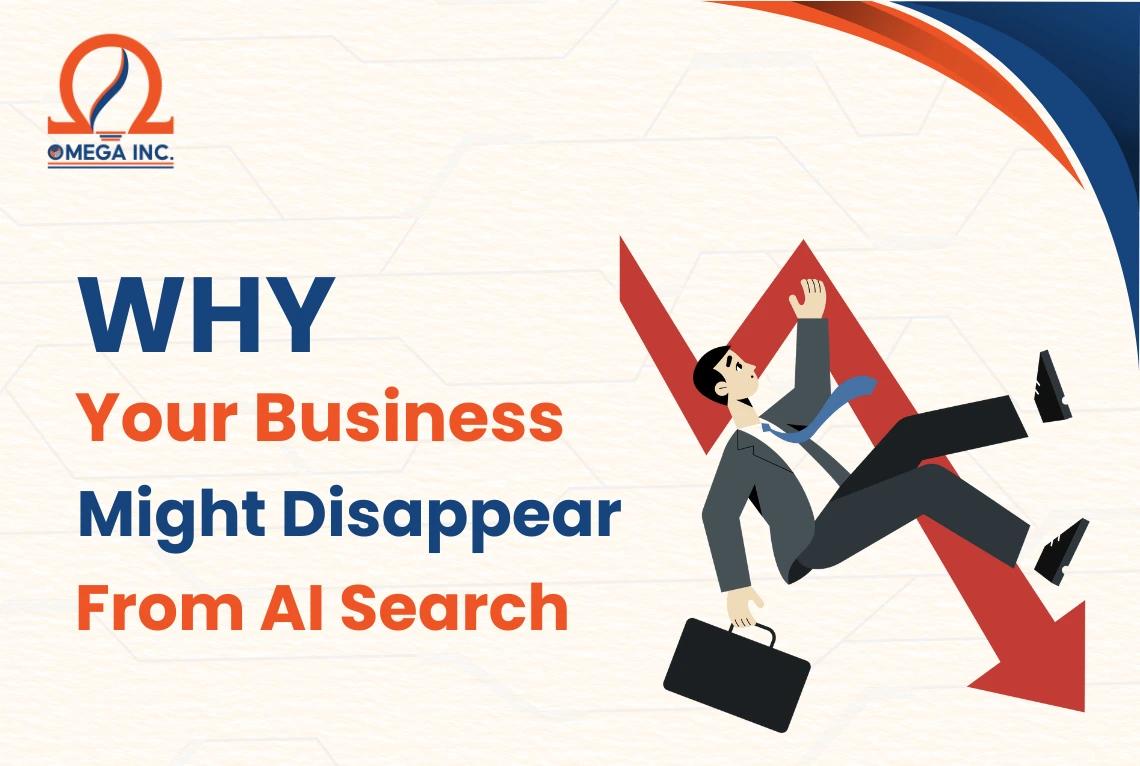
In 2026 a customer may ask a conversational AI for a recommendation and never click a single link. The answer will appear as a neat, synthesized summary that cites a handful of trusted sources, and your website might not be one of them. That’s not a distant prediction. It’s happening now as search shifts from lists of links to answer-driven experiences. If your content isn’t structured, credible, and machine-readable, the AI will simply ignore it when compiling its response.
In this post you’ll learn why AI search ranking has been rewired, the technical and content mistakes that cost businesses ChatGPT visibility, and a practical 12-month playbook you can use today to defend your presence in AI SEO results.
If you need a primer on the basics, check out What Is Digital Marketing? Strategy Breakdown for Small Businesses for useful digital visibility fundamentals before you dive in.
The new rules of AI search ranking: why summaries beat links
Search used to reward the best link placement. Today, generative engines reward being a source.
AI-driven summaries, sometimes called AI Overviews or generative answers, synthesize text across multiple pages and present a single distilled response. Users get answers fast. Publishers get fewer clicks. That’s the core shift: visibility is no longer only about being #1 on a page; it’s about being cited as an authority inside the summary.
Why it matters:
Fewer traditional clicks means lower organic CTR for many queries.
AI picks sources it perceives as trustworthy and extractable, not necessarily the highest-ranking link.
Being cited in an AI summary often sends more qualified, intent-driven leads than rank alone.
Practical example: a local service query. Instead of listing five plumbers, the AI will show a short answer naming the top recommended firms and a brief rationale. If your business isn’t structured or cited, it won’t appear even if you outrank competitors in classic SERPs.
This reality turns SEO into a new discipline. You now optimize for extractability and citation-worthiness, not only for ranking algorithms.
Technical blockers that kill ChatGPT visibility
Technical issues are the easiest problems to fix and the ones that most often stop AI from reading your content.
Common blockers:
Machine-readability problems: Heavy client-side rendering, content hidden behind JavaScript, or pages that serve important information only after user interaction make it hard for AI crawlers to extract facts.
Blocked crawlers and misconfigured robots: If GPTBot, other OAI crawlers, or even Googlebot are blocked by robots.txt or bot-sensitive CDN settings, your pages won’t be ingested.
Content locked in non-HTML formats: PDFs, images, and downloadable docs often contain your best facts but are poorly parsed unless you provide HTML summaries.
Performance and mobile issues: Slow pages and poor mobile layouts reduce the likelihood that AI will consider your content a reliable source for answers.
Technical quick wins:
Render critical copy server-side or use prerendering so content exists in HTML at page load.
Audit robots.txt, sitemap, and crawler logs to confirm GPTBot and major bots can fetch key pages.
Convert important PDFs into HTML landing pages or provide succinct HTML summaries with download links.
Optimize Core Web Vitals and make website mobile friendly since fast, stable pages are easier to extract and more likely to be trusted.
Content that AI cites: E-E-A-T, original data and human signals
AI systems favor sources they can trust. That’s where E-E-A-T - Experience, Expertise, Authoritativeness, Trustworthiness - matters more than ever.
How to become citation-worthy:
Publish original research, case studies, or exclusive data. AI loves first-hand sources because they add unique value that gets cited.
Show real human expertise. Include detailed author bios with credentials and links to professional profiles or publications.
Use transparent methodology. If you cite a stat, explain how it was collected and when — dated, reproducible content reads as honest and credible.
Build third-party mentions. Authoritative sites referencing your work create signals AI uses to map your entity into its knowledge graph.
Keep business information consistent. NAP (Name, Address, Phone) consistency across Google Business Profile, industry directories, and partner sites reinforces trust.
Content type checklist for AI SEO success:
Actionable case studies with measurable outcomes.
How-to guides that start with a short, direct answer.
FAQ sections that anticipate conversational queries.
Whitepapers or data downloads with an accompanying HTML summary.
For content planning and conversion tactics, see Content Marketing Strategy for 2025.
Markup and format that make AI copy you: schema, FAQ, and conversational structure
Structured data is the grammar of AI. The more explicit you make your content’s purpose, the easier it is for models to extract and correctly cite it.
High-impact markup:
Organization and Article schema to define your brand and authorship.
FAQPage and HowTo schema for Q&A and stepwise content — these are especially friendly to AI Overviews.
Product schema for service pages with pricing, availability, and features.
Formatting rules that help AI:
Use question-based headings. If AI is answering “How much does X cost?”, having an H2 that mirrors that question increases extractability.
Put concise answers in the first 50–70 words of each section. Generative engines often extract short, precise bites.
Keep content scannable: short paragraphs, clear bullets, and H3 subheads beneath each H2.
Example authoring tip: Add a short JSON-LD FAQ snippet for any page that answers user questions. That tiny bit of markup can make the difference between being cited and being invisible.
The 2026 playbook: immediate fixes and a 12-month roadmap to protect visibility
This is the practical portion which provides a prioritized plan you can implement immediately and iterate on over a year.
Immediate (0–30 days)
Run a crawl audit and check robots.txt for blocked bots.
Convert top-performing PDFs to HTML summaries.
Update your top 10 landing pages to an answer-first format (short lead, then supporting detail).
Add or update author bios on all long-form content.
Short term (1–3 months)
Apply FAQPage and Article schema to service and pillar pages.
Publish two original case studies or a data-driven whitepaper.
Fix Core Web Vitals and mobile UX issues on priority pages.
Ensure NAP consistency across Google Business Profile and directories.
Medium term (3–12 months)
Launch an outreach program to secure authoritative mentions and backlinks.
Build topic hubs (pillar + cluster model) to create a clear entity graph for your brand.
Set up monitoring for AI citations. A weekly review of where your brand is being referenced in AI Overviews or answer boxes.
KPIs to measure:
Number of times your content is cited in AI summaries (qualitative tracking).
Change in organic click-through rate for target keywords.
Lead volume generated from pages updated for AI extractability.
Growth in authoritative backlinks and brand mentions.
When to call an agency
If your audit shows multiple technical blockers, or if you lack resources to produce original research and outreach, that’s the time to get external help. The right outsourcing partner who can combine technical SEO, secure development, and content strategy will accelerate results, which is where Omega Incorporations fits in: we handle the dev, the schema, and the outreach while keeping your data secure.
Conclusion
AI-driven search will keep evolving. The winners will be the businesses that make their content easy for machines to read, clearly authoritative for humans, and valuable enough to be cited. This isn’t just a technical problem, it’s strategic.
Start with the immediate fixes. Add original content and structured data. Then seed outreach and measure citations. Do this, and you won’t just survive the AI transition. You’ll be the source the AI chooses to quote.
If you want help auditing your site, implementing schema, or creating the case studies that attract citations, contact us and we’ll build a secure, measurable plan to restore and grow your ChatGPT visibility in the age of AI SEO.
FAQs
1. What is the difference between classic SEO and AI SEO?
Classic SEO optimizes for ranking signals and clicks; AI SEO focuses on making content extractable, trustworthy, and citation-worthy so generative engines will use it in answer summaries.
2. Will adding FAQ schema guarantee my site appears in AI answers?
No. FAQ schema helps AI parse content and increases the chance of citation, but you still need strong E-E-A-T, original content, and crawl accessibility.
3. How do I check whether GPTBot can crawl my site?
Review your server logs for GPTBot user agents, audit robots.txt, and use crawl simulators; if you see blocked requests, update your settings to allow legitimate AI crawlers.
4. Are PDFs useless for AI visibility?
Not useless, but less effective. Provide HTML summaries of PDF content so AI can extract key facts and still link to the full download for depth.
5. What’s the fastest way to improve my chances of being cited by AI?
Publish at least one original, data-driven piece (a case study or whitepaper), add clear author credentials, and ensure the page uses Article/FAQ schema and is server-rendered so it’s immediately machine-readable.